
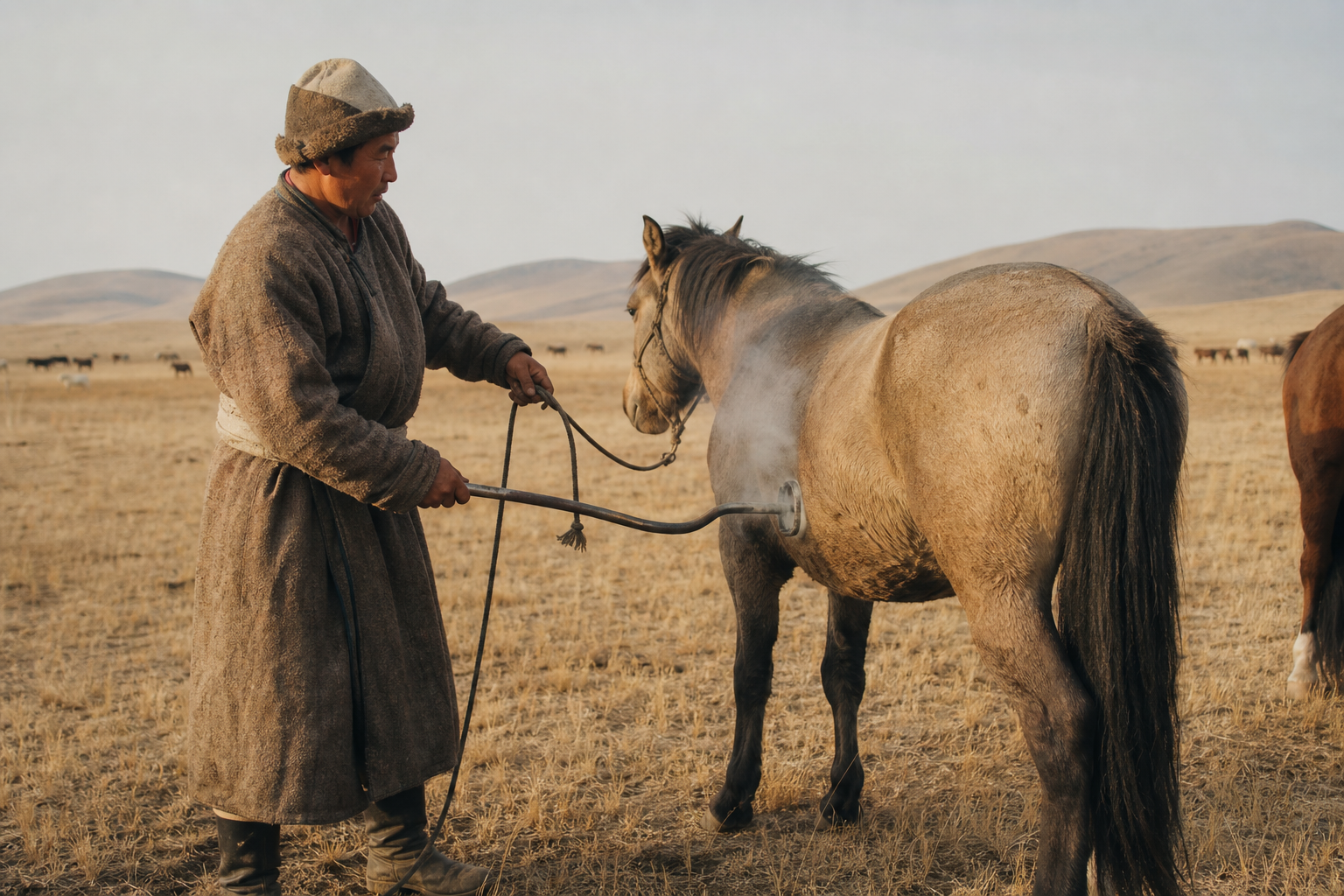
Somewhere on the steppe, three thousand years ago, a nomad with a hot iron pressed a mark into the flank of a horse. The mark identified the animal as belonging to a specific family, or clan, or tribal grouping. It was a simple act with a simple purpose: in a world without fences, where herds grazed freely across vast grasslands and could intermingle, mix, scatter, or be stolen, a durable visible symbol was the most practical available technology for asserting ownership.
That mark was a tamga. And the story of how a cattle brand became a clan emblem, a seal of sovereignty, a fiscal instrument of the Mongol Empire, a form of diplomatic currency on the Eurasian steppe, and eventually a living element of national identity in modern Kazakhstan, Kyrgyzstan, Mongolia, and Ukraine is one of the more remarkable trajectories in the history of human symbolic systems.
What the Word Means and Where It Comes From
The word "tamga" (also spelled "tamgha" or "tamag'a") means "stamp" or "seal" in Mongolian. According to the linguist Gerard Clauson, writing in 1972, it was originally a Turkic word used for a Chinese-style seal that passed into Mongolian with essentially the same meaning. The word and the practice it names traveled widely: versions of "tamga" appear in Persian, Arabic, Russian, and across the Turkic languages of Central Asia, carried by the populations that used the symbol.
In its narrowest definition, a tamga is an abstract emblematic symbol used by a specific tribe, clan, or family. It is not a pictogram representing a real-world object; it is not a letter from an alphabet; it is not a religious image. It is a distinctive geometric or linear mark, generally compact enough to be branded onto an animal's hide or incised into a stone surface, that functions purely as an identifier. It says: this belongs to us, or: we were here, or: we swear by this.
The tamga was the heraldic system of the Eurasian steppe, developed independently of and many centuries before the formal heraldry of Western Europe, and adapted to the specific needs of pastoral nomadic societies: portable, durable, transmissible across generations, immediately legible to those who knew the visual vocabulary, and illegible to outsiders in a way that protected its identifying function.
Prehistoric and Ancient Roots
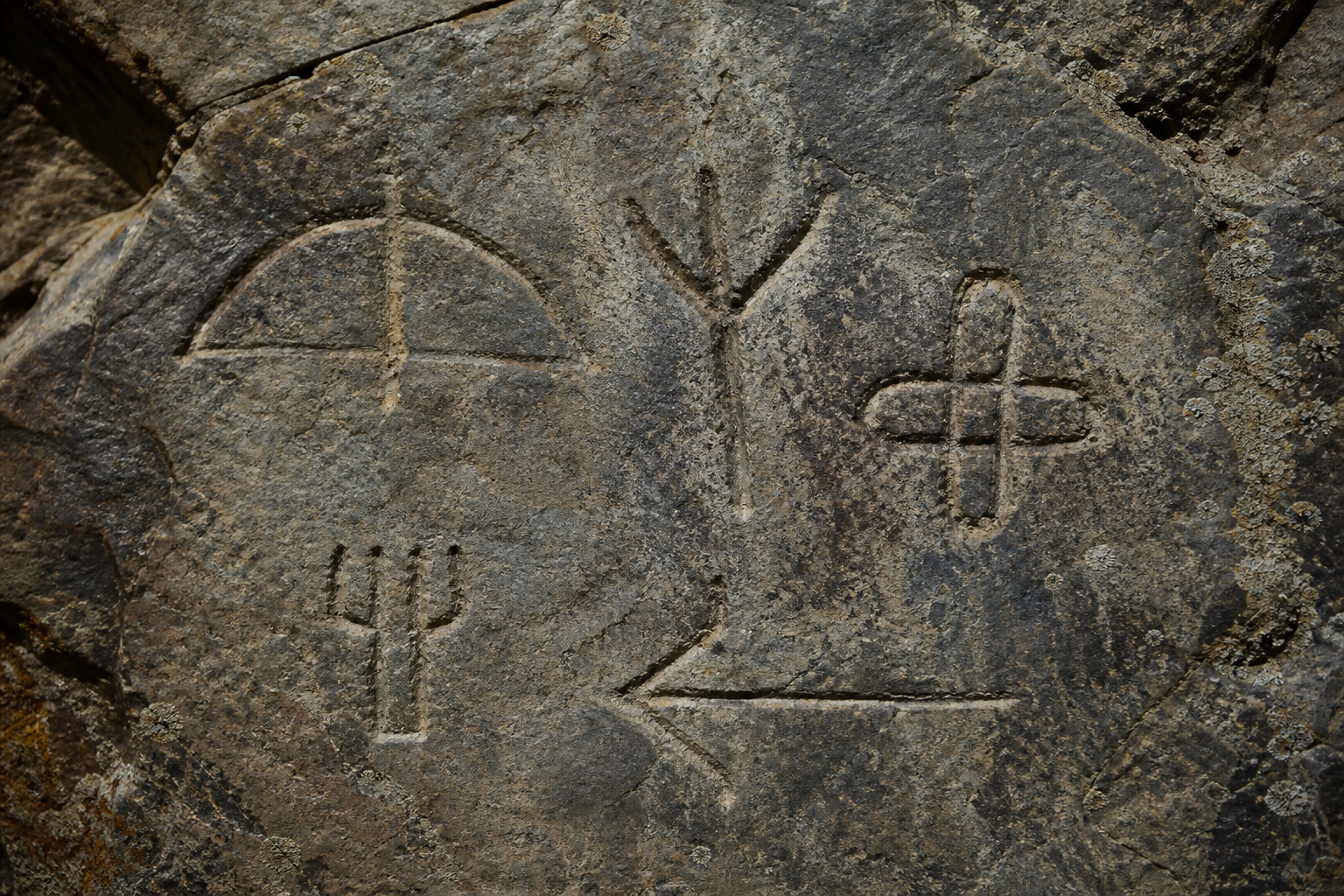
Tamgas, or tamga-like symbols, appear in the archaeological record long before the historical period from which we have written sources. Rock art sites across Central Asia, southern Siberia, the Altai mountains, and the Pontic-Caspian steppe contain abstract incised marks that archaeologists interpret as functionally equivalent to later documented tamgas: symbols recording presence, claiming territory, or identifying groups. The methodological challenge is that without written sources to anchor interpretation, the function of prehistoric symbols is always somewhat inferential.
The earliest historically documented tamga-using cultures include the Scythians and Sarmatians, Iranian-speaking nomadic peoples who dominated the Pontic steppe from roughly the 7th century BCE onward. Scythian and Sarmatian material culture from the Black Sea region and Central Asia includes personal and clan marks on goldwork, weapons, and portable objects. These signs were used to denote ownership, lineage, and sometimes what appear to be political allegiances within confederations of related groups.
Chinese chronicles and archaeological excavations of Xiongnu sites, dating from the 3rd century BCE to the 1st century CE, document tamga-like brands and engravings on cauldrons, rock art, and horse equipment. The Xiongnu were a major confederation of nomadic peoples from the eastern steppe who became the dominant power on China's northern frontier during the Han Dynasty; the five tamga-like symbols associated with the Xiongnu khagan's authority were later claimed by Genghis Khan as emblems of his own dynasty, suggesting a continuity of symbolic legitimation running from the steppe world's early confederations into the Mongol period.
Among Iranian-speaking steppe groups including the Alans and Sarmatians, tamga signs were also used as dynastic symbols in the Bosporan Kingdom, the Greek-influenced state on the northern shores of the Black Sea that lasted from the 5th century BCE to the 4th century CE. The Bosporan kings stamped their coins with tamga-like symbols, and this practice influenced the later use of similar symbols by the Khazar Khanate and, through the Khazars, by the Rurikid princes of Kievan Rus.
Function in the Nomadic World: More Than a Brand
The cattle brand is the most immediately practical function of the tamga, and it remained central to the institution throughout its history. In a pastoral economy where herds could intermingle during seasonal migrations, stray in storms, or be claimed by rival groups, the ability to identify animals quickly and unambiguously was economically vital. A tamga branded on a horse or cattle mark was the nomadic equivalent of a property deed.
But the tamga carried functions well beyond property identification. Within the political structures of steppe confederations, the tamga was the visual marker of lineage and political affiliation. Each clan maintained a distinct tamga, passed down patrilineally and applied consistently to members' property. When clans confederated into larger political units, the tamgas of constituent groups were sometimes combined or modified to reflect the new relationship: adding a mark to the original, or creating a composite form, while preserving the underlying genealogical reference.
In diplomatic and legal contexts, the tamga functioned as a seal in the most literal sense: an authenticating mark that validated agreements, treaties, and property transfers. Historical records from Central Asian sources document the use of tamgas on envoys' standards and branded gifts during treaty negotiations, where displaying the correct tamga affirmed an alliance commitment. A mismatched or unfamiliar tamga on a diplomatic gift could signal deception or enmity.
The Kazakh practice of shejire, the oral recitation of genealogical lineages that can extend back twenty or more generations, was cross-referenced with tamga marks: the symbols incised on petroglyphs and inscribed on artifacts could be matched against the oral genealogical record to verify or contest claims of descent. Surveys in southeastern Kazakhstan have matched over a hundred documented tamgas from 14th to 19th-century nomadic sites to contemporary clan narratives. The tamga thus functioned not only as a present identifier but as an archive of historical claims.
In dispute resolution, displaying a tamga established a claim to legitimacy that went beyond individual testimony. Multiple tamgas incised together on a rock surface could record an alliance, a treaty conclusion, or a gathering of multiple groups for a significant collective purpose. The rock at Ulytau mountain in central Kazakhstan bears multiple tamgas representing different clan unifications, and similar assemblages appear at other historically significant sites in Mongolia and Kyrgyzstan.
The Turkic and Mongol Period: Sovereign Emblems and Coins
The tamga reached its greatest political elaboration during the Turkic Khaganates of the 6th to 8th centuries CE and the subsequent Mongol Empire of the 13th to 14th centuries.
In the Turkic Khaganates that dominated Inner Asia from roughly 552 CE onward, tamgas became the emblems of ruling lineages and were used on seals, coins, and official documents alongside inscriptions in the Orkhon script, one of the earliest written scripts developed for Turkic languages. The Orkhon inscriptions themselves, carved on stone stelae in Mongolia in the 8th century and among the most important documents for understanding early Turkic history and culture, are accompanied by tamga marks identifying the clans and dynasties associated with particular texts.
Within the Mongol Empire established by Genghis Khan in the early 13th century, the tamga took on an additional, crucial meaning: it became a fiscal and commercial instrument. A tamgha in the Mongol administrative system referred to a seal placed on goods that had been taxed, confirming that the appropriate customs or transit duties had been paid. By extension, the tamgha became the name for the tax itself: a commercial transit tax charged at markets, river crossings, and trading posts throughout the empire.
This fiscal tamgha was one of the Mongol Empire's most significant administrative innovations, and it shaped commerce across Eurasia from China to the Black Sea. Italian merchants trading at Mongol-controlled ports in the Crimea encountered it, as did merchants operating along the Silk Roads through Central Asia. The word entered Persian, Arabic, and Russian administrative vocabulary in this sense: in medieval Russia, "tamga" came to mean a commercial tax, a usage that persisted into the Tsarist period. A specialist thesis from Cambridge University documents how tamga as a form of trading taxation evolved from its Mongol origins through the various successor states of the Mongol Empire across the 13th to early 16th centuries, comparing fiscal practices at either end of the Silk Roads.
Tamgas appear on Islamic coins issued by the descendants of Genghis Khan across the various khanates of Central Asia during the 13th and 14th centuries, particularly in the Chaghatai Khanate. The Aq Qoyunlu and Qara Qoyunlu, rival Turkmen confederations that competed for control of Anatolia and Iran in the 15th century, placed their tamgas on their flags and stamped their coinage with them, using the tribal symbol as a mark of sovereign legitimacy in a context where formal dynastic heraldry had not yet fully supplanted the older steppe tradition.
The Rurikid Trident: Tamgas in Kievan Rus
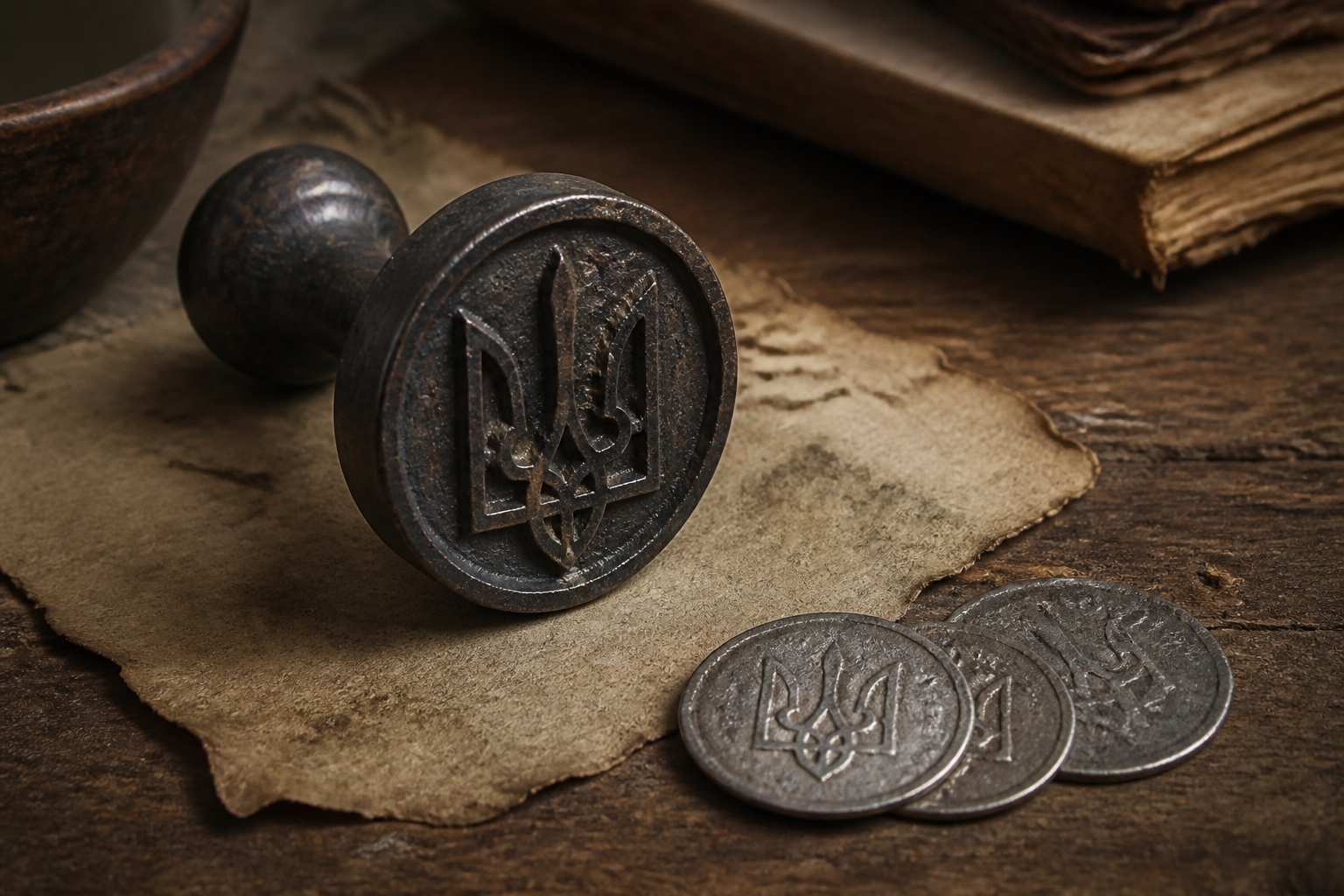
One of the most consequential stories of a tamga's migration from steppe to sedentary society is the history of the trident symbol that the Rurikid princes of Kievan Rus used as their dynastic emblem from the 9th through the 12th centuries, and that the modern state of Ukraine uses as its coat of arms today.
The Rurikid knyazes used individual tamga-like symbols to denote their personal authority, marking coins, seals, property, and eventually church bricks with distinctive emblems. These symbols were personal rather than dynastic in the Western heraldic sense: each prince devised his own variant, typically related to but distinct from his predecessors' marks, so that the overall pattern of Rurikid symbols across generations shows a family of related forms rather than a single stable emblem.
The trident form that became most closely associated with the dynasty appears on the coins of Vladimir the Great (r. 980–1015) and his successors. According to the historian Omeljan Pritsak, this stylized trident tamga was derived from Khazar precedents: bident and trident tamga forms were known from the 8th and 9th centuries in the Khazar world on belt ornaments, on the stones of Khazar fortresses, and as pottery stamps. The Khazar Khanate was the major political power north of the Caucasus and around the Caspian during this period, and the Rurikids' relationship with the Khazars included the borrowing of both the title "khagan" and, quite possibly, elements of their symbolic vocabulary.
An Arabic account from the 10th century describes Rus raiders taking hostages and leaving their seal in the form of a clay token bearing their mark as a receipt that protected former hostages from recapture. The practice, functionally identical to the steppe use of tamgas as diplomatic authentication, illustrates how thoroughly the Rurikids had absorbed steppe political culture even as they built a more complex territorial state.
When Ukraine adopted the trident as its national coat of arms in 1918, during the brief existence of the Ukrainian People's Republic, and then again after independence in 1991, the choice consciously invoked the Rurikid legacy as a symbol of Ukrainian historical continuity. The modern Ukrainian state thus carries a tamga, transformed over a millennium from a personal princely mark into a national emblem.
Sedentarization and the Fate of the Tamga
As Turkic and Mongol nomadic groups settled into more urban or agricultural ways of life, the tamga typically lost its practical function and with it its cultural prominence. The Turks who took over western Anatolia after the Battle of Manzikert in 1071 and established the Sultanate of Rum became, over generations, Roman-style aristocrats for whom the clan mark on a horse's hide was increasingly irrelevant. In eastern Anatolia and Iran, Turkic groups who remained pastoral maintained their tamgas and elevated them into nationalist imagery: the Ak Koyunlu and Kara Koyunlu flags with their tribal emblems are examples of this dynamic.
For Turkic and Mongolic groups who never left the steppe, the tamga simply remained what it had always been. In Mongolia today, the president passes the "tamag" (state seal) to his or her successor as part of the inauguration ceremony. Herders across Mongolia and Kazakhstan still brand livestock with family tamgas, using curved irons that identify animals across shared pastures exactly as their predecessors did millennia ago.
The Kazakh Case: 84 Tamgas and Three Hordes
Kazakhstan offers the most systematically documented case of a living tamga tradition. Scholars have counted 84 distinct tamgas of Kazakh clans, descended from 43 tribes, organized within the three major zhuz (hordes): the Uly Zhuz (Great Horde) of southern and southeastern Kazakhstan, the Orta Zhuz (Middle Horde) of central and northeastern Kazakhstan, and the Kishi Zhuz (Little Horde) of western Kazakhstan. Within each zhuz, subclans exhibit variations on the parent clan's tamga that denote sub-lineage affiliation.
Kazakh tamgas are typically geometric or semi-geometric forms, often derived from common shapes such as bows, arrows, crosses, and various looped or branched configurations. Each tamga has both a visual form and a name: the Baganaly clan's tamga, for example, takes its name from the formal term for that specific form. The combination of visual and linguistic identity made the tamgas accessible both to literate and illiterate community members. A Kazakh herder who could not read could still recognize and correctly attribute a tamga by its distinctive shape and name.
The tamga's relationship to the oral genealogical tradition in Kazakhstan is particularly strong. The shejire, the patrilineal genealogical recitation that every Kazakh was traditionally expected to know back seven generations, was corroborated and preserved by the tamga marks found on family property, on ancestor gravestones, and carved into landscape features. Contemporary Kazakh families often know their family tamga even when other traditional practices have faded, and some use it on personal seals or family documents.
In Kazakhstan today, the tamga tradition is explicitly connected to national identity. The official government narrative traces the lineage of Kazakhstan's national emblem from Bronze Age totem signs through the term "tamga" as formalized in the Turkic Khaganate. Livestock branding with tamga irons continues in Kazakh villages. The three zhuz and their associated tamgas remain socially meaningful, even in a modern state where formal ethnographic identity is less publicly prominent than it was in Soviet times.
The Tamga as Archaeological Evidence
For archaeologists and historians working on the steppe world, tamgas are a first-order source. Because they were applied to durable surfaces (stone, metal, fired clay, hard leather) and because they were repeated consistently by members of a given group across long time periods, they provide a means of tracking the movement of specific clans and tribal groupings across the landscape. Rock inscriptions bearing a particular tamga in southeastern Kazakhstan, when matched against the same mark appearing in Altai rock art a thousand kilometers away, suggest the migration path of the group that used it. Multiple tamgas accumulated at a single site suggest the gathering of multiple groups for a significant purpose: a treaty, a battle, a seasonal market, a festival.
The work of researchers like A.E. Rogozhinsky and S.A. Yatsenko has systematically catalogued tamga corpora across Central Asia, attempting to trace the movements of Iranian-speaking and then Turkic-speaking nomadic groups through the distribution patterns of their marks. This approach treats the steppe landscape as a kind of billboard covered in unintentional historical documentation, where successive groups left their identifying marks at significant waypoints, watering holes, and territorial boundaries.
The methodological challenge is that tamgas were not always unique to a single group: similar geometric forms sometimes appear in widely separated contexts that cannot be connected to the same population, suggesting either convergent development of similar solutions to similar problems, or the influence of a widely shared aesthetic vocabulary across the steppe world. Reading tamgas as historical documents requires triangulating across multiple lines of evidence rather than treating any single mark as definitively identifying a specific group.
From Steppe to State: The Tamga's Modern Life
The tamga's trajectory from practical cattle brand to emblem of sovereignty is complete in modern Central Asia. Kazakhstan's national emblem, officially adopted in 1992 following independence, draws explicitly on the tamga tradition as one of its conceptual foundations: the shanyrak (the circular lattice opening at the top of a yurt) at the center of the emblem is described in official Kazakh state publications as a symbol in the tradition of the ancestral tamga, now encoding not clan identity but national unity.
In Kyrgyzstan, Mongolia, and among Turkic communities in Russia and the Central Asian republics, tamgas and tamga-like symbols appear in contexts ranging from traditional livestock management to decorative arts, architectural ornamentation, and nationalist political imagery. The claim that a contemporary community's identity connects to ancient steppe heritage is often made through tamga symbolism: the mark that says "this belongs to us" now says "we have always been here."
In Ukraine, the trident whose steppe-derived origins have been traced through the Rurikids and back to the Khazar tamga tradition is one of the most politically freighted symbols in the world today. The flag bearing that trident flies over a country whose fight for existence is partly a fight over exactly the kind of historical continuity and identity that the tamga has always encoded.
A stamped mark on a horse's flank, pressed there by a nomad three thousand years ago on a Central Asian steppe, turns out to carry a very long history.
References
- Cambridge University Repository. (2024). Tamga: A fiscal form in post-Mongol Moscow. repository.cam.ac.uk/items/e7d2f271-9ae9-4517-9b7a-00382b820e4f
- E-History Kazakhstan. (2025). Historical background of the national symbols of the Republic of Kazakhstan. e-history.kz/en/news/show/28666
- Grokipedia. (2026, January 17). Tamga. grokipedia.com/page/Tamga
- HandWiki. (2026). Tamga. handwiki.org/wiki/Tamga
- Kazakh Tamgas (PDF). Academia.edu. academia.edu/40851109/Kazakh_Tamgas
- Rogozhinsky, A.E., & Cheremisin, D.V. (2019). The tamga signs of the Turkic nomads in the Altai and Semirechye: comparisons and identifications. Archaeology, Ethnology and Anthropology of Eurasia, 47(2), 48–59.