
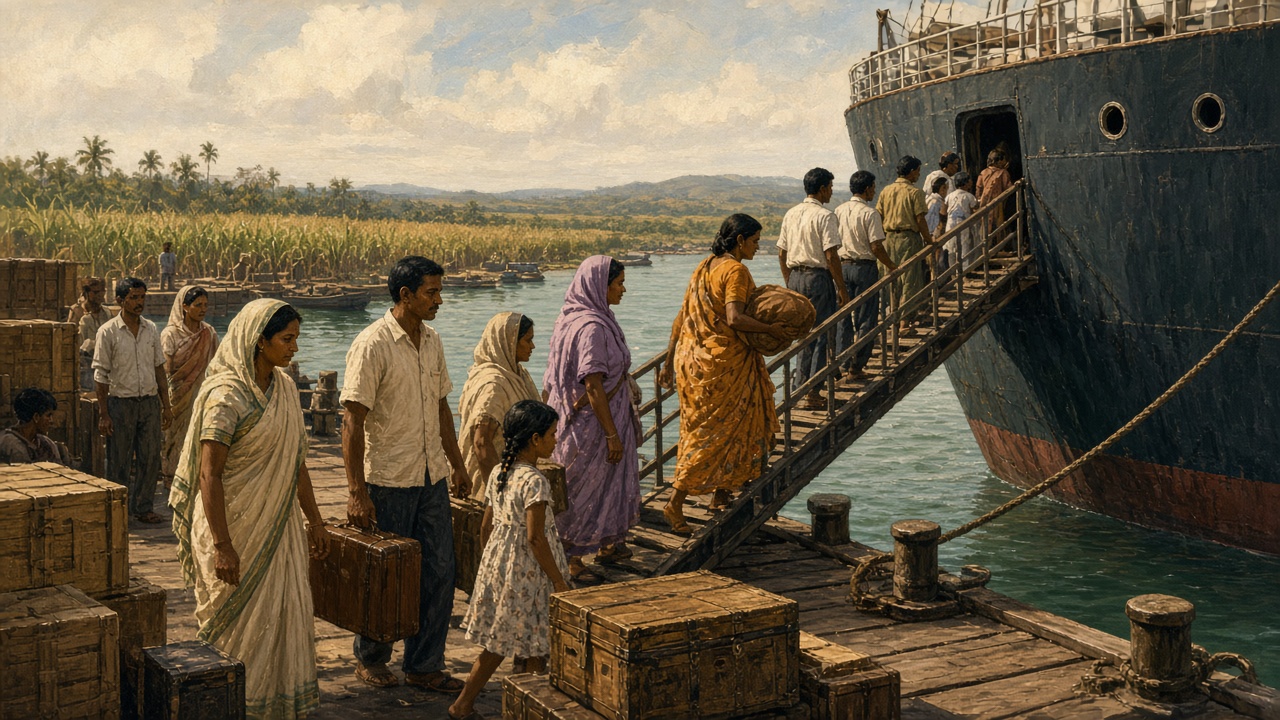
The first crossing began on May 5, 1838, when two ships, the Whitby and the Hesperus, arrived in British Guiana with laborers recruited in Calcutta. Over the following eighty years, more than half a million people from British India were taken to sugar colonies in the Caribbean under contracts of indenture. Their descendants, today called Indo-Caribbeans, became the largest ethnic group in Guyana, Trinidad and Tobago, and Suriname.
The second crossing is less well known. It began after World War II and is still under way. It carried Indo-Caribbeans out of the Caribbean, to the Netherlands, the United States, Canada, and the United Kingdom, and it carried a different kind of Indian migrant into the Caribbean, merchants and professionals who came by choice rather than contract. Together, these movements redrew the map of the Indo-Caribbean world. A Hindu temple on a converted row house in Queens, a Hindustani-speaking community in Rotterdam, and a Sindhi-owned duty-free shop in Sint Maarten are all part of the same story, and all of them belong to the decades after 1945.
This article follows that story, using the "Post World War II trends" section of the standard encyclopedic overview of Indo-Caribbean people as its starting point and adding the historical context needed to make sense of it.
What the Section Actually Says
The section on post-war trends is an interesting document, partly because of what it contains and partly because of what it does not. Read closely, it is less a narrative of postwar change than a demographic snapshot of the Indo-Caribbean world as it stood by the late twentieth century. Its main points are these.
Origins within India. The majority of Indians living in the English-speaking Caribbean came from eastern Uttar Pradesh and western Bihar, regions that are largely Hindi-speaking. Those brought to Guadeloupe and Martinique were largely from Andhra Pradesh and Tamil Nadu. About 20 percent of the indentured population were Tamils and Telugus, particularly in Trinidad and Tobago and in Guyana. A minority came from other parts of South Asia, including present-day Pakistan and Bangladesh.
Standing within national populations. Indo-Caribbeans are the largest ethnic group in Guyana, Trinidad and Tobago, and Suriname. They are the second largest group in Jamaica, Grenada, Saint Vincent and the Grenadines, Saint Lucia, Martinique, and Guadeloupe.
Small communities elsewhere. There are smaller communities in Anguilla, Antigua and Barbuda, the Bahamas, Barbados, Belize, French Guiana, Panama, the Dominican Republic, Puerto Rico, and the former Netherlands Antilles. In Haiti, small groups exist whose members are sometimes mistakenly called "mulattos."
The overview then moves into two adjoining sections that complete the post-war picture: contemporary migration, which concerns Indian migrants who came after indenture, and the diaspora, which lists the places Indo-Caribbeans have moved to, including the United States, Canada, the Netherlands, France, the United Kingdom, Ireland, and other parts of the Caribbean and Latin America.
One honest observation is in order. The section heading promises a story about change after 1945, but most of its text describes who the Indo-Caribbeans were and where they lived, which is the legacy of the indenture era. The postwar dynamics sit mainly in the neighboring sections and in the scholarship behind them. That is the material this article assembles.
Who Came: The Regional Layers of the Indo-Caribbean Population
The postwar story makes more sense once the earlier layers are clear, because the communities that moved after 1945 carried those layers with them.
The bulk of indentured migrants to the English-speaking Caribbean came from the Bhojpur and Awadh regions of the Hindi Belt, in what are now eastern Uttar Pradesh and western Bihar. Their languages, Bhojpuri and Awadhi, blended on the plantations into Caribbean Hindustani, which survives today in Trinidad, Guyana, and especially Suriname, where it is known as Sarnami. Their religious culture was overwhelmingly Hindu, with a significant Muslim minority and smaller Christian, Sikh, and other groups. The religious mix is part of why Indo-Caribbean communities abroad sustain both temples and mosques.
The South Indian stream is smaller but distinctive. About one fifth of indentured laborers were Tamils and Telugus, strongest in Trinidad and Guyana, and the French departments of Guadeloupe and Martinique drew their indentured population largely from Andhra Pradesh and Tamil Nadu. A scholarly study of migration and identity among people of South Indian descent in the Caribbean, covering Guyana, Trinidad, and Suriname and following the diaspora to Britain, the Netherlands, the United States, and Canada, shows that South Indian heritage persisted as a distinct strand even as it merged into a broader Indo-Caribbean identity.
The gender profile of the original migration also shaped later demography. Women made up only about a quarter of those who emigrated from India to the Caribbean, and the ratio of women to men was extremely low in the early decades, according to the figures cited in the standard overview. Colonial authorities set quotas to raise the proportion, and by the end of the indenture era, policy had shifted toward encouraging settlement, including land grants to former indentured men. Marriages by Hindu and Muslim rites were not legally recognized by the colonial government until the 1940s, which meant that many married women were classified as single and denied the limited privileges afforded to wives. These details matter for the postwar period because the 1940s mark the point at which Indo-Caribbean family life began to be recognized in law, just as the community began to settle into a more permanent political presence.
The Map in Numbers
By the late twentieth century, the Indo-Caribbean population was large and unevenly distributed. Estimates of the total vary widely, from about 1.5 million in older versions of the standard overview to about 2.5 million in more recent ones, partly because of different definitions and partly because mixed-heritage populations are counted inconsistently.
The most commonly cited figures in the overview's infobox give a sense of scale. Trinidad and Tobago had roughly 468,000 to 470,000 people of Indo-Caribbean descent at the time of the 2011 census, a plurality of the population, and a more recent edition gives a figure of about 534,000. Guyana had 297,493 in the 2012 census, also a plurality. Suriname had 148,443. Outside the region, the infobox lists 232,817 Indo-Caribbean Americans, about 200,000 Indo-Caribbeans in the Netherlands, about 100,000 in Canada, and 25,000 British Indo-Caribbeans in older versions, a figure revised to 53,000 in a more recent one. In the French Caribbean, Martinique has about 36,000 and Guadeloupe about 35,600. Jamaica has roughly 21,600.
The instability of these numbers is itself informative. The Indo-Caribbean population is not a settled statistical category. It is a moving one, shaped by migration, intermarriage, and the choices people make about how to identify.
The Postwar Setting: Decolonization and New Doors
Several large forces converged after 1945 to turn Indo-Caribbean communities into migrants.
The first was decolonization. The British Caribbean colonies moved toward independence in the 1960s, with Trinidad and Tobago and Jamaica independent in 1962 and Guyana in 1966. Suriname, a Dutch colony, followed in 1975. In each case, independence reshaped the political position of the Indo-Caribbean population, which was a numerical plurality or a significant minority competing for power with Afro-Caribbean populations and other groups. Anxiety about what independent governments would mean for each community became a decisive factor in the decision to leave.
The second was labor demand and changing immigration law in the destination countries. In Britain, the independence of India in 1947 and a postwar labor shortage opened the door to mass immigration from the subcontinent, and Caribbean migrants of all backgrounds also traveled to Britain in the 1950s and early 1960s. In the United States, restrictions on immigration from Asia and the Caribbean eased in stages, with decisive changes in 1965 that opened the way for large-scale migration from the "global south," including West Indians. In the Netherlands, postwar labor needs and the legal status of Surinamese as Dutch nationals created a corridor that would carry tens of thousands of people.
The third was economic and political crisis at home, which varied by country and is the most important explanation of why different Indo-Caribbean populations moved at different times.
Suriname and the Netherlands: A Near-Exodus
The Surinamese case is the clearest example of political change driving migration. Until independence in 1975, all Indo-Surinamese were formally Dutch nationals. As the independence date approached, many Hindustani Surinamese, concerned that a nationalist government would bring oppression of their community, left for the Netherlands in large numbers, keeping their Dutch passports. Accounts describe a near-exodus in 1975.
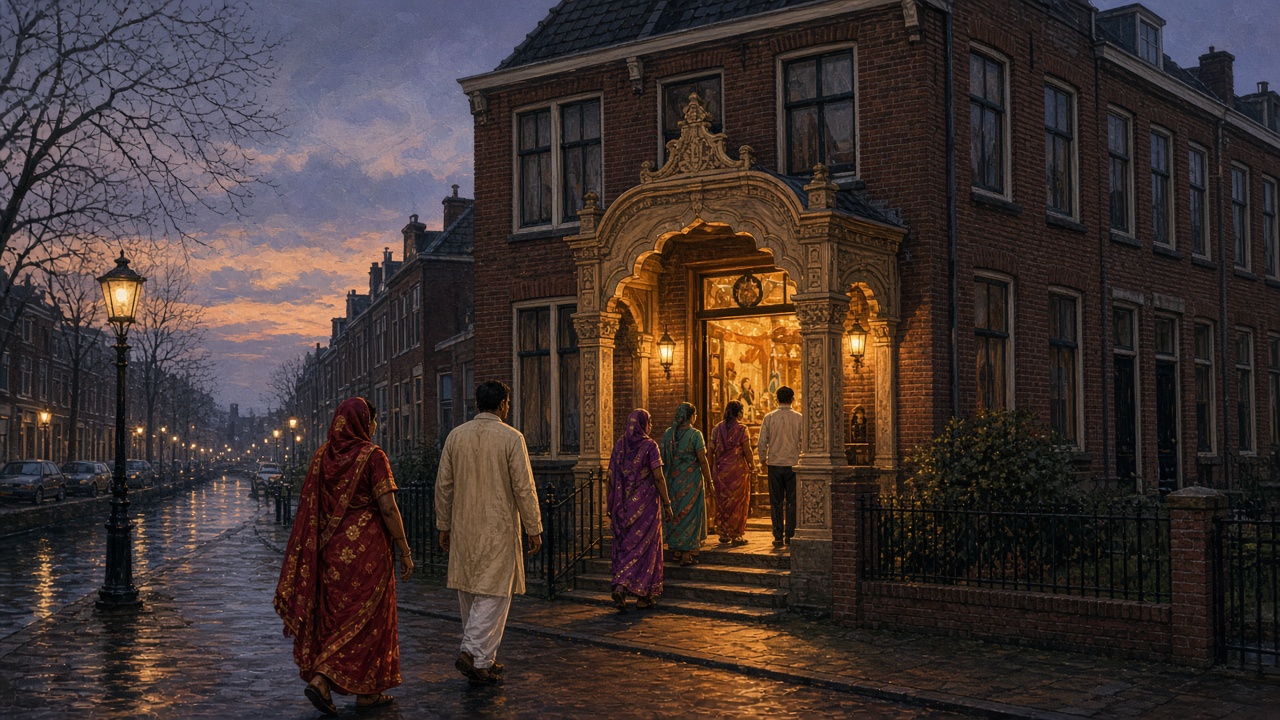
One feature of this episode is counterintuitive. The Dutch state had expected that moving quickly toward independence would reduce the migration flow. In reality the opposite happened, and migration to the Netherlands increased. Researchers describe two main waves: one around independence in 1975, and a second around the military coup led by Desi Bouterse in February 1980. By the time of independence, some 30,000 people had already moved to Guyana and Curaçao, and some had passed through Suriname on the way to the Netherlands. Estimates of the number of Surinamese Hindus who settled in the Netherlands after independence range from 80,000 to 100,000.
Overall, about 350,000 people of Surinamese descent now live in the Netherlands, a number that includes all ethnic groups. The Indo-Caribbean component is estimated at about 200,000 in the standard overview. Studies of Hindustani women who moved to the Netherlands emphasize that, for many, migration was a socioeconomic leap forward, giving access to material comforts that were unavailable in Suriname, and that they have since entered nearly every profession. Most Surinamese South Asians in the Netherlands settled in and around the larger cities, particularly the Hague and Rotterdam.
Some Indo-Guyanese also appear in the Dutch statistics, because many Guyanese in the Netherlands descend from people who had lived in Suriname and migrated with the Surinamese after 1975.
Guyana, Trinidad, and the Gateway Cities of North America
For the Anglophone Caribbean, the destination of choice shifted toward North America.
After Guyana became independent from Britain in 1966, Guyanese immigration to the United States increased dramatically. Guyana's political troubles under the governments of Forbes Burnham and his successor, which one Guyanese commentator dates from 1965 to 1992, are widely cited as a major push factor. That account describes persecution that led many Guyanese to emigrate to the United States, Canada, and Britain, and later throughout the Caribbean and northeastern South America. At the same time, the changes to US immigration law in 1965 acted as a pull factor. As one analyst puts it, after establishing residency in gateway cities, typically New York and Toronto, Guyanese immigrants then sent for family members. Between the 1970s and the late 1980s, an estimated 10,000 Guyanese migrated each year, a figure that included many professionals leaving in a "brain drain."
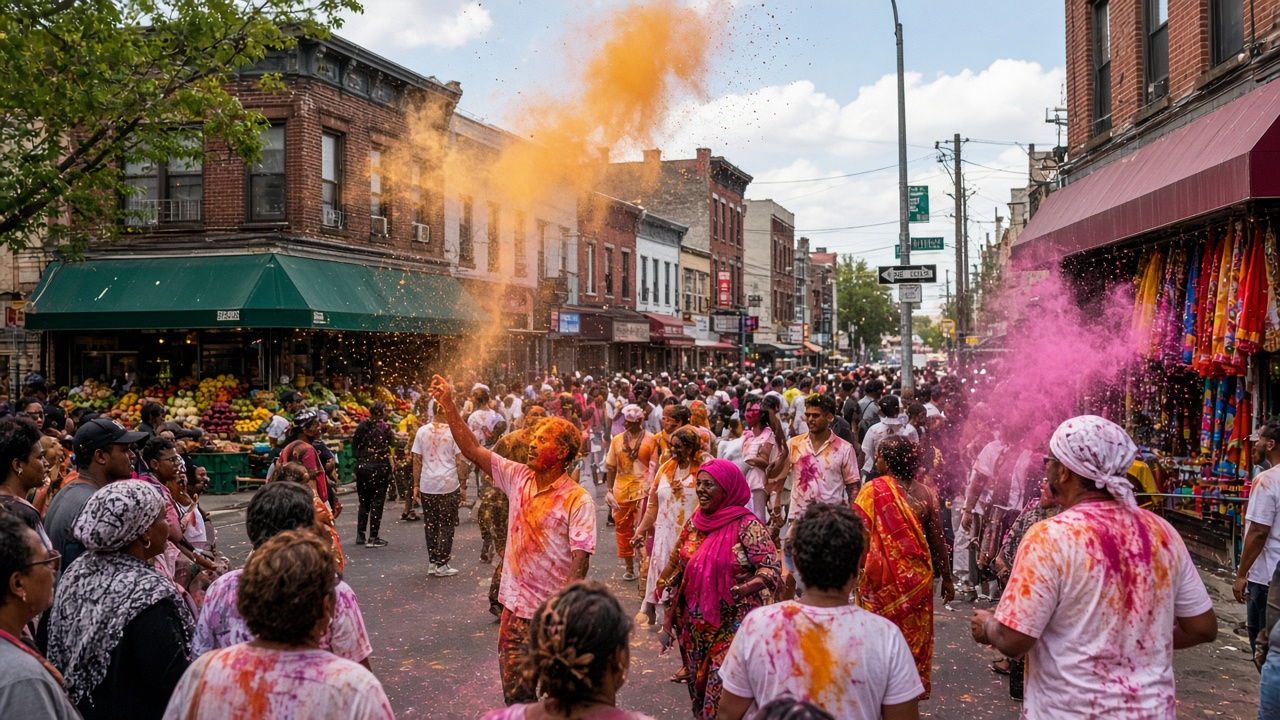
The settlement pattern in New York is well documented. Early Guyanese arrivals in the late 1960s and 1970s came as students at technical and trade schools and as visitors, living in low-rent areas of Manhattan and Queens. They tried to settle in Richmond Hill in the late 1970s, but encountered resistance from long-established Irish and Italian residents, and a significant clustering of Indo-Caribbeans in the neighborhood began only in the early 1980s, as the older white population moved away. The area along Liberty Avenue came to be known as Little Guyana, a name that was used informally from the mid-1980s and made official in 2021, when part of the avenue was formally co-named Little Guyana Avenue. The 2000 census counted 24,662 people in Richmond Hill who were born in Guyana, most of them of Indian descent. Richmond Hill also became the site of the Phagwah parade, described as the largest Holi celebration in the United States.
The story has its own internal tension. Indo-Trinidadians also settled heavily in the same area, and one estimate attributed to the mayor's office in the late 1980s put the number of Indo-Trinidadians in greater Richmond Hill at about 105,000, compared with about 90,000 Guyanese. Numbers like these are rough and should be treated with caution. In recent years, the neighborhood has also seen newer South Asian arrivals, including a Punjabi community that led to the naming of a "Little Punjab," a development that has prompted Indo-Caribbean residents to assert their own claim to the space.
Further north, an Indo-Caribbean population of about 100,000 lives in Canada, with Toronto as its center. Indo-Caribbean media reflect the community's presence there: Toronto has been home to several Indo-Caribbean newspapers, including the Indo-Caribbean World.
Britain, France, Ireland, and the Wider Caribbean
Britain was among the earliest postwar destinations. Caribbean Indians moved to the United Kingdom in the decades after the war, though their numbers have remained smaller than in North America or the Netherlands. The standard overview lists 25,000 British Indo-Caribbeans in older versions and 53,000 in a more recent one, a reminder of how unsettled these counts are.
The French Caribbean has a distinctive postwar path. Indo-Caribbeans in Martinique and Guadeloupe, who are second largest in those populations, are French citizens living in overseas departments, and their relationship to the metropole has produced migration to mainland France. In 2003, Martinique marked the 150th anniversary of Indian arrival, and Guadeloupe did the same in 2004. These events were treated as official recognition by French and local authorities of the community's integration and wide-ranging contributions to agriculture, education, politics, and the diversification of Creole culture, and they involved the whole multiethnic population of the two islands, not only the Indian minority.
Smaller streams went to Ireland and to other parts of the Caribbean and Latin America. Indo-Caribbean workers and their descendants also appear in the standard overview's list of a "secondary" diaspora in Venezuela, Panama, Brazil, Argentina, and Colombia.
Contemporary Migration: Merchants, Doctors, and Refugees from East Africa
A second movement runs in the opposite direction, from India into the Caribbean, and it is entirely different in character. It is also part of the postwar story, because it involves people who came after indenture ended, as free migrants.
The standard overview notes that modern-day immigrants from India, mostly Sindhi merchants, are found on Saint-Martin and Sint Maarten, St. Thomas, Curaçao, and other islands with duty-free commercial capabilities, where they are active in business. Other Indo-Caribbean people descend from later migrants, including Indian doctors, Gujarati businessmen, and migrants from Kenya and Uganda. The last group points to a wider movement of South Asians out of East Africa in the later twentieth century.
A minority of the Indo-Caribbean population thus descends from people who migrated as entrepreneurs, businesspeople, merchants, engineers, doctors, religious leaders, and other professionals beginning in the middle of the twentieth century. Their experience was very different from that of indentured laborers. They arrived with capital or professional credentials, spoke different Indian languages, such as Sindhi and Gujarati, and often maintained closer ties to India. A scholarly chapter on non-indentured Indian migration to the Caribbean since World War II treats these arrivals as a distinct phase, separate from the indenture-era movement and the later movement of Indo-Caribbeans to Europe and North America.
Identity: Who Is "Indo-Caribbean" After Two Crossings?
The postwar movements have complicated the question of identity. The terms in use reflect that. People of this heritage are variously called Indo-Caribbeans, Caribbean Indians, Caribbean Hindustanis, South Asian Caribbeans, or Caribbean Desis. Many in the diaspora refer to themselves as East Indian West Indians, a phrase that appears on the storefronts of grocery and clothing businesses in places like Florida and New York and that captures the double belonging of people with roots in both the East and the West Indies. The older word "coolie" is now considered derogatory.
Intermarriage has produced mixed groups, among them the Dougla (mixed Indian and African), Indo-Amerindian, Chindian (Indian and Chinese), and others. Many Indo-Caribbeans have ethnically blended with other groups, creating what the overview calls a syncretic culture.
Commemoration has become an important marker of belonging. Indian Arrival Day is celebrated on May 30 in Trinidad and Tobago, where it has been a holiday since the 1990s and commemorates the arrival of the Fatel Razack in 1845. Guyana marks it on May 5, Jamaica on May 10 or 13 in different accounts, St. Vincent on June 1, Suriname on June 5, and St. Lucia on May 6. These holidays turn a history of labor and displacement into public recognition of contribution.
The result is a population whose identity is layered. A person in Richmond Hill may be Indo-Guyanese by origin, American by citizenship, Hindu or Muslim by religion, and attached, through food, music, and festival, to a Caribbean world and, through memory, to a Bihari or Tamil village that their ancestors left in the nineteenth century. The phrase "twice migrants," common in the scholarship, captures the point: first from India to the Caribbean, then from the Caribbean to the global north.
Cautions and Open Questions
Several limits on the available picture deserve mention.
First, population figures are uncertain and inconsistent, as the shifting numbers in successive editions of the standard overview show. Some counts include mixed-heritage people and some do not.
Second, the unit of analysis matters. "Indo-Caribbean" lumps together populations with very different histories. Indo-Surinamese migration to the Netherlands was shaped by Dutch citizenship and a colonial legal framework. Indo-Guyanese migration to New York was shaped by political repression and US immigration law. Indo-Trinidadian movement followed its own pattern. Treating them as one stream obscures these differences.
Third, a good deal of the popular material on the Little Guyana neighborhood and similar enclaves is community journalism and memoir. It is valuable but impressionistic, and systematic quantitative studies of the spatial formation and labor market participation of Indo-Guyanese in Queens are only beginning to appear.
Finally, the standard overview itself is a work in progress, and its section headings do not always match their contents. The material on the postwar period is best read as a starting point.
Conclusion
The Indo-Caribbean story does not end with indenture. After 1945, the descendants of the first crossing became a mobile, transnational people. Decolonization changed the politics of the societies they lived in. New immigration laws opened destinations that had been closed. Political crises in Suriname and Guyana pushed families out, and economic opportunity in New York, Toronto, and the Dutch cities pulled them in. At the same time, new Indian migrants, Sindhi merchants, Gujarati traders, doctors, and East African refugees, arrived in the Caribbean by choice.
The outcome is a community of roughly one and a half to two and a half million people, depending on who is counting, spread from the sugar belt of Guyana to the avenues of Queens. They remain recognizably connected: by festivals such as Diwali and Phagwah, by languages and foods, by commemorations of arrival, and by a shared memory of a crossing that began in 1838. The second crossing did not break that connection. It extended it across the Atlantic and the Americas, and it turned a Caribbean story into a global one.
References
- Gotham Center for New York City History. (n.d.). Schlep in the city: Little Guyana. gothamcenter.org/blog/schlep-in-the-city-little-guyana
- Global Voices. (2023, June 5). A journey through three continents: 150 years of Indian Caribbean migration to the Netherlands. globalvoices.org/2023/06/05/a-journey-through-three-continents-150-years-of-indian-caribbean-migration-to-the-netherlands/
- Guyana Chronicle. (2021, May 21). The emergence of "Little Guyana" in America. guyanachronicle.com/2021/05/21/the-emergence-of-little-guyana-in-america/
- Laurence, K. (1994). A question of labour: Indentured immigration into Trinidad and British Guiana, 1875–1917. St Martin's Press.
- Leiden University Scholarly Publications. (n.d.). Chapter on South Asian migration from Suriname to the Netherlands [Open-access publication]. scholarlypublications.universiteitleiden.nl/access/item%3A2924127/download
- Mahavidya. (n.d.). Hindu diaspora. mahavidya.ca/?p=109
- Roopnarine, L. (2007). Indo-Caribbean indenture: Resistance and accommodation, 1838–1920. University of the West Indies Press.
- Taylor & Francis. (n.d.). Migration from Suriname to the Netherlands and Hindustani women [Book chapter]. taylorfrancis.com/books/9780429443619/chapters/10.4324/9780429443619-4
- JSTOR. (n.d.). Table of contents: A study of migration and identity among people of South Indian descent in the Caribbean and its diaspora [Open-access book]. jstor.org/stable/j.ctv5jxnw8