
There is a word in English that means, simultaneously, a garment worn by monks and nuns and an automatic pattern of behavior so deeply ingrained it operates without conscious thought. That the same word covers both meanings is not a coincidence. It is a compressed history of how a civilization understood the relationship between the body, the will, and the formation of the self.
The word is "habit."
Its trajectory from Latin to French to English carries within it a theology, a philosophy of mind, and a sociology of religious life that illuminates not just the garments themselves but the entire project of Christian monasticism. And when you look at the habits that specific Christian religious orders developed, and the vocabulary that grew up around them, you find that the history of clothing and the history of language are telling the same story in different registers.
The Etymology: What "Habit" Holds
The English word "habit" entered the language in the early 13th century, and its first recorded meaning was specifically the characteristic clothing worn by a religious order. Chaucer uses it in this sense in the Canterbury Tales. But the word's Latin root, habitus, carried a much broader and philosophically richer set of meanings.
Habitus is the past participle of habere, "to have, to hold, to possess." In Latin, habitus referred to the state or condition of something: its manner of being, its bearing, its appearance. Cicero used it in a philosophical sense when he wrote that virtue is an animi habitus naturae modo atque rationi consentaneus, "a condition of the mind consistent with nature, moderation, and reason." The Stoics used habitus to describe the stable dispositions that constitute character: the habits of virtue or vice that a person has cultivated through repeated action until they become second nature.
From "condition" the word moved to "how one conducts oneself" and from there to "the visible expression of how one conducts oneself," which is to say, clothing. The logic is continuous: what you are shows in how you carry yourself, and what you wear is part of how you carry yourself. The outer and the inner are related because the outer is a declaration and a practice of the inner.
What makes the word's English history particularly curious is that it entered English in precisely the reverse order of this Latin development. In Latin, habitus meant condition first and clothing later. In English, habit meant clothing first (13th century) and acquired mode of behavior later (14th century). As Merriam-Webster notes, "the order of meanings absorbed from one language to another rarely constitutes a logical development." The clothing sense came through Old French habit, meaning clothes and ecclesiastical garb, and it was the monks' garment that native English speakers encountered most visibly and named first.
This reversed trajectory means that in English, the word "habit" carries its philosophical meaning as a kind of metaphorical extension of the monastic garment. When we say someone has "good habits" or "bad habits," we are, etymologically, speaking of the condition of their soul using the language of monastic dress. The clothing came first, in English, and the behavior followed, as if the garment had taught us to speak of character.
The Desert Fathers: Where the Garment Began
The Christian religious habit has identifiable origins in a specific historical moment: the 3rd and 4th centuries CE, in the deserts of Egypt, Palestine, and Syria, where the first Christian monks withdrew from urban life to pursue radical asceticism in conditions of physical hardship.
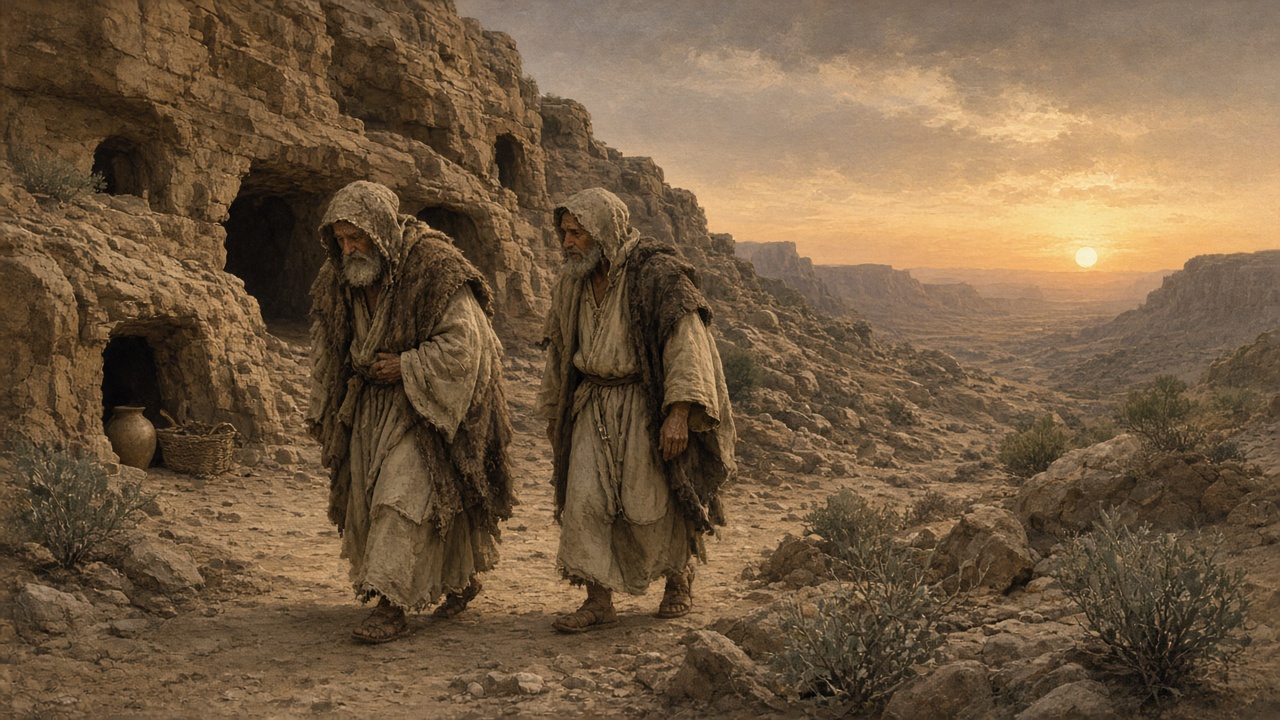
These Desert Fathers, as they came to be called, were not initially organized into communities with standardized dress. Their garments were simple by necessity and theology simultaneously: rough tunics of undyed wool or linen, goatskin mantles, minimal footwear. The simplicity was practical but also intentional. In the religious culture of late antiquity, elaborate dress was a marker of social status, wealth, and worldly aspiration. To dress simply was to renounce all of that in a single visible gesture.
The first systematic account of monastic dress comes from Saint Pachomius (294–346 CE), who established the first cenobitic, that is, communal, monasteries in Egypt. Pachomius introduced what is recognized as the first organized religious habit: a sleeveless linen tunic held by a cincture, a tanned goatskin or sheepskin cloak, and a small cape attached to a hood bearing a special badge identifying the monastery. The hood was particularly significant; it became a defining feature of Eastern monastic dress and the source of the word "cowl" (from Latin cuculla, a hood), which persists in descriptions of monastic garments to the present.
John Cassian (350–447 CE), who traveled extensively among the Egyptian monasteries and brought their practices to the Latin West, provides the most detailed early description of monastic dress and its symbolic meaning. For Cassian, each element of the monk's clothing carried theological significance. The girdle or cincture represented the mortification of bodily desires. The hood represented the simplicity of a child, uncorrupted by adult worldly ambition. The scarf around the neck represented the yoke of Christ. Cassian was doing explicitly what the habit would do implicitly for centuries: teaching the wearer to read his own body as a theological text.
Saint Basil the Great (329–379 CE), who observed monastic life in Egypt and brought it to the Eastern Roman Empire, articulated the habit's function in terms that would echo through the subsequent tradition: it was "an effective instrument to make a monk realize his station in life and to keep him from indecorous conduct." The garment was a daily reminder, worn on the body, of the commitments made at profession.
Saint Benedict and the Western Synthesis
The figure who did most to shape Western Christian monasticism, and through it the visual culture of the monastic habit in Europe, is Benedict of Nursia (c. 480–547 CE), whose Rule, written around 530 CE, became the dominant framework for monastic life in the Latin West.
The Rule of Saint Benedict says surprisingly little about the specific form of the habit: Benedict was characteristically practical, noting that the appropriateness of clothing varies by climate and leaving the details to the discretion of the abbot. What he did specify was that clothing should be simple, sufficient, and whatever is cheapest and most readily available in the region. He explicitly mocked the practice of wearing special clothing to distinguish oneself, insisting that the habit should mark the monk's membership in the community, not his personal distinction within it.
The color that came to define the Benedictine habit, black, appears to be a historical accident that acquired theological weight over time. Black dye was cheap in 6th-century Italy, a practical consideration that shaped the visual identity of the Western monastic tradition. The theology that grew around the color followed the practice: black came to signify the death of the former self. The person who enters the monastery has, symbolically, died to their old identity. The black habit is a visible burial garment for a self that is understood to have been left at the door. This is not incidental to Benedictine spirituality; it is close to its center. Conversion of life, one of the three vows Benedict specified alongside stability and obedience, implies a fundamental reorientation of selfhood, and the black tunic is its daily visible sign.
The vocabulary of Benedictine dress contributed several words to the broader English lexicon. The cowl (cuculla), the wide-sleeved outer garment worn for choir and solemn occasions, entered English from the Benedictine tradition. The scapular (from Latin scapulae, shoulders), the wide panel of cloth that crosses the shoulders front and back, was originally a practical work apron and became so central to monastic dress that receiving the scapular eventually became a formal liturgical rite of clothing in many orders. The word "cloister" (from Latin claustrum, an enclosed space) describes the covered walkways around a monastery's central garden, but also the entire enclosed life of the monk; "cloistered" as an adjective applied to any person of unusual seclusion carries the monastic origin visibly.
The Mendicant Orders: Habit as Mission
The 13th century produced a different relationship between the religious habit and the world around it. Where Benedictine monasticism was built on stability and enclosure, the new mendicant orders founded by Francis of Assisi and Dominic de Guzman were designed for mobility and engagement. Their habits were shaped accordingly.
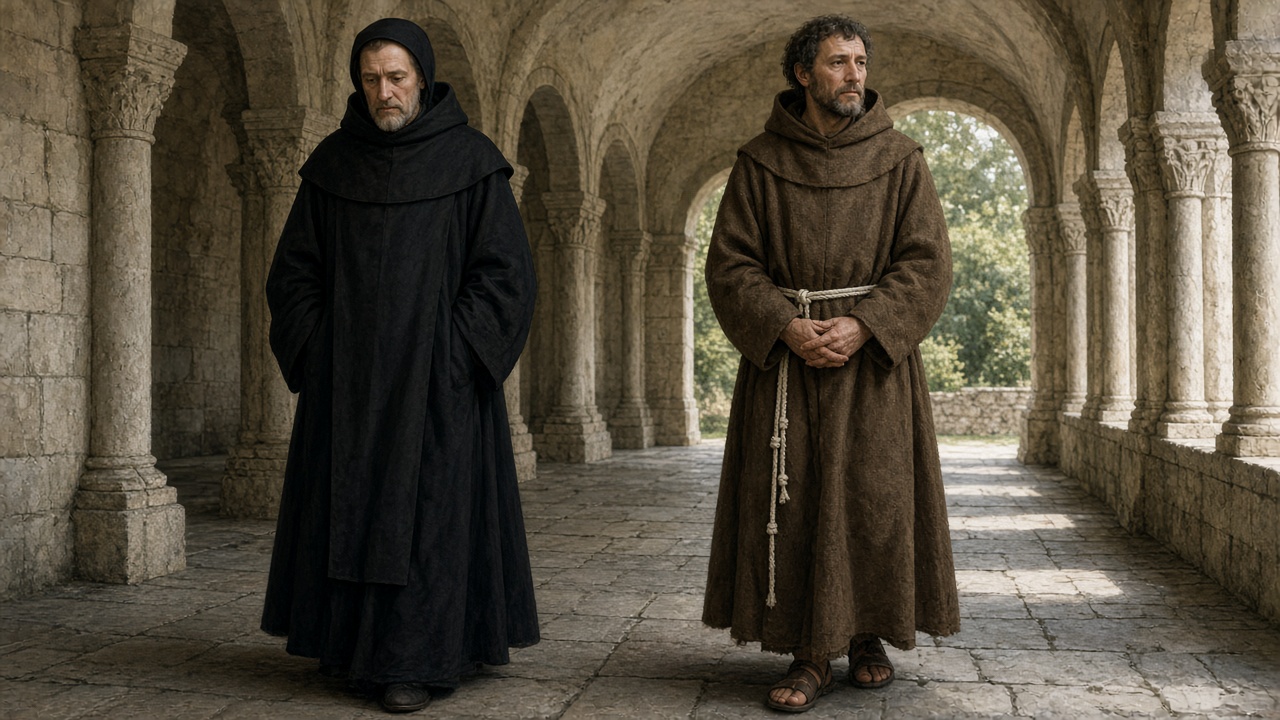
Francis of Assisi (1181–1226 CE) designed what would become the Franciscan habit from the material logic of radical poverty. He wanted clothing that was indistinguishable from the dress of the poor people among whom he and his brothers would minister. The result was a tunic of undyed brown or grey wool, the cheapest and least processed cloth available in medieval Europe, with a deep practical hood and a belt not of leather but of knotted white rope. The three knots in the cord explicitly represented the three vows of poverty, chastity, and obedience: the Franciscan friar carries his vows visually around his waist every day. The color of the habit, varying from brown to grey depending on the branch of the order, gave rise to the color names "franciscan brown" and "grey friar," the latter becoming one of the common English names for Franciscan friars themselves.
The word "friar" (from Old French frere, from Latin frater, brother) itself distinguished the mendicants from monks: a monk is enclosed in a monastery, while a friar moves through the world. The distinction was linguistically necessary because the reality was new: mobile, street-level religious poverty that looked like lay poverty but was chosen rather than imposed. Francis did not design a habit to separate his brothers from the poor; he designed one that would make them visually continuous with the poor while marking their voluntary status. The habit in this context is not a barrier between the religious and the world but a statement of identification.
Dominic de Guzman (1170–1221 CE) founded the Order of Preachers in response to a specific theological crisis: the Cathar heresy in southern France, which was thriving partly because the Catholic clergy who were supposed to combat it lived in visible luxury. Dominic's insight was that the most effective counter was not argument alone but witness: a life of poverty and learning that matched the rigor of the Cathar perfecti. The Dominican habit, black and white, encoded this dual identity: white for the purity of the preaching vocation, black for the dignity of the choir and the presence in the world. The black mantle worn over the white tunic gave rise to the English colloquial term "blackfriar" for Dominicans, still preserved in London's Blackfriars neighborhood, built on the site of a Dominican friary dissolved in 1538.
The Dominican emphasis on preaching required education, and the order built a network of schools and later universities. The habit its members wore in those universities, lecture halls, and courts where they served as inquisitors became one of the most recognizable garments in medieval Europe. The Dominicans' formal name in English, "Friars Preachers," encodes their functional identity in language, just as the black-and-white habit encodes it in cloth.
Women's Habits: Enclosure, Reform, and the Veil
The history of women's religious habits in Christianity follows a trajectory partly parallel to men's but shaped by additional factors: the theology of female enclosure, the social regulation of women's mobility, and the visual language of widowhood and virginity.
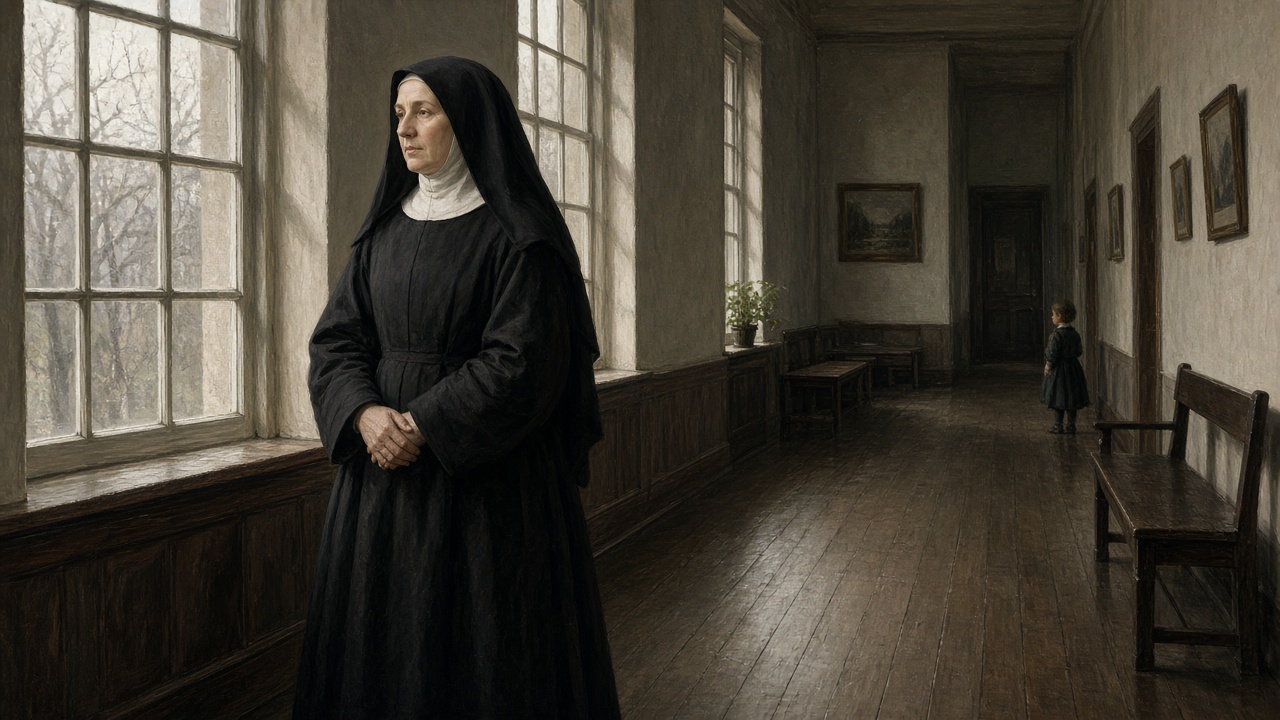
Early women's monasticism in Egypt and Syria used forms of dress analogous to men's: simple tunics, veils, and mantles that signified renunciation of worldly concern. The veil was particularly significant because of its established cultural meaning in late antiquity: veiled women were women who had placed themselves under the protection of a household or a community, out of the circuit of male public gaze. For women consecrated to God, the veil signified a marriage to Christ, a betrothal that superseded all earthly marriage possibilities and placed the woman's identity under divine rather than human authority.
The vocabulary of women's religious life in English reflects this theology. "Nun" comes from Late Latin nonna, a term of address for an elderly woman, parallel to the male nonnus applied to monks, eventually specialized to mean a woman in religious life. "Abbess" comes from the same root as "abbot," the Aramaic abba (father), through the feminine form abbatissa. "Prioress" is the feminine form of "prior," meaning "earlier" or "superior," indicating the head of a priory. Each of these words carries the organizational hierarchy of the institution in its morphology.
The 19th century produced a distinctive American chapter in the history of women's religious dress. Elizabeth Seton, who founded the first American religious order, the Sisters of Charity, in 1809, and Cornelia Connelly, who founded the Society of the Holy Child Jesus in England in 1846, both adopted forms of dress derived from the "widow's weeds," the simple black mourning dress that respectable widows wore in the 19th century. This was not an arbitrary aesthetic choice. Widow's weeds were already a legible cultural sign of a woman who had removed herself from the marriage market, who was no longer socially available in the ways that young women were expected to be. For founders who wanted to create communities of women dedicated to work in education and social service rather than enclosed contemplation, the widow's dress was the closest available cultural form to what they needed: identifiable, modest, serious, and carrying an aura of independence from ordinary social expectations.
The Second Vatican Council and the Habit's Modern Fate
The Second Vatican Council (1962–1965) produced a document, Perfectae Caritatis, on the renewal of religious life, which addressed the question of habits directly. It called for habits to be appropriate to the order's charism, suitable for modern apostolic work, and adapted to local cultures. This relatively open-ended language was interpreted very differently by different orders.
Some communities substantially modified or abandoned the traditional habit, reasoning that it was a barrier to the apostolic engagement the council was calling for and that contemporary lay dress was a more appropriate expression of identification with the people being served. Others maintained the traditional habit in full, arguing that it was an essential sign of witness in a secular culture and that its visibility was part of its apostolic function. A significant number of communities that had modified their dress in the 1970s and 1980s returned to more traditional habits in the 1990s and 2000s, often in response to what members described as the habit's value as a visible sign of religious identity in a culture that had largely forgotten what a nun or a friar looked like.
The debate over the habit is, at one level, a debate about function: does visible distinctiveness serve or impede the mission? But at a deeper level it is a debate about the relationship between outer form and inner reality that was already implicit in the word "habit" itself. Those who maintained the habit argued that the garment shapes the person who wears it, that daily life in distinctive dress forms a distinctive identity, that the habit is not merely an expression of a prior spiritual state but a practice that helps constitute it. Those who abandoned it argued that the commitment to the mission and community is what matters, that the garment is a cultural contingency rather than a theological necessity, that the inner habit does not require the outer one.
Both positions were arguing about the same thing the Latin word had always held: whether clothing and character are separable or continuous.
The Language the Habit Taught
Centuries of monastic life in Europe left behind a vocabulary that remains in everyday English, visible in words whose origins most speakers do not register.
"Cloister" (a covered walkway, an enclosed life) gives English "sequestered" as a concept and "cloistered" as an adjective for anyone unusually withdrawn from worldly affairs. "Cowl" (the monk's hood) persists in technical vocabulary for any hood-shaped structure, including the cowling of an engine. "Scapular" (the shoulder garment) survives in Catholic devotional practice and in the anatomical term for the shoulder blade. "Chapel" comes from the Latin capella, originally the cloak of Saint Martin of Tours that was carried as a relic; the priest who carried it was called a capellanus, giving English "chaplain." "Breviary" (the book of daily prayers) comes from Latin breviarium, an abridgment, reflecting the compression of the Divine Office into portable form. "Monastery" comes from the Greek monasterion, from monos, alone, encoding the original solitary character of the first monks even as it describes a communal institution.
And then there is "habit" itself: the word that began as a philosophical term for the condition of the soul, traveled through the clothing of those who claimed to have stripped the soul down to its essentials, and arrived in English as the name for both the garment and the behavioral pattern it was meant to embody. Every time an English speaker uses the word "habit" in its everyday behavioral sense, they are using a term that carries, buried within it, the theology of the Pachomian desert, the Rule of Saint Benedict, the poverty of Francis, the preaching vocation of Dominic, and centuries of men and women who believed that what you wear every day shapes who you become.
The habit does not make the monk, the proverb says. But the word that names both the garment and the behavior suggests that whoever coined the proverb was arguing against a very old and persistent intuition that it does.
References
- Encyclopedia.com. (n.d.). Religious habit. encyclopedia.com/religion/encyclopedias-almanacs-transcripts-and-maps/religious-habit
- Etymonline. (n.d.). Habit. etymonline.com/word/habit
- Merriam-Webster. (n.d.). Habit. merriam-webster.com/dictionary/habit
- Merriam-Webster Wordplay. (n.d.). What do a nun's habit and a mini-skirt have in common? merriam-webster.com/wordplay/habit
- Medieval Shop Blog. (2025). Monk robes: A journey through the history and meaning of monastic habits. blog.medieval-shop.co.uk/monk-robes-a-journey-through-the-history-and-meaning-of-monastic-habits.html
- Oxford University Press Blog. (2011, April). An etymologist looks at habits and customs. blog.oup.com/2011/04/habit/
- Religious Habits of Different Christian Orders. (2026). Clergy Wear Shop. clergywearshop.com/religious-habits-christian-orders/